Make PDFs smaller with Lossless Compression
Losslessly recompress your existing archive on the PyMuPDF stack you already run. No migration. No new format. Just a smaller bill.
Text stays text. Images stay images. We just pack it tighter.

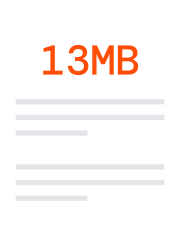

One parameter. No migration.
Recompress existing PDFs with doc.save() and choose from multiple compression options without changing your workflow.
import pymupdf

doc = pymupdf.open("archive.pdf")
doc.save(
    "compressed.pdf",
    use_objstms=True,
    deflate=1,
)
doc.close()
Compress with Flate.
Compresses the packed streams with standard Flate, the same algorithm used in ZIP files. Supported by every PDF viewer and tool.
What each option actually does.
A 1.8MB test file, compressed with each setting below.
use_objstms=Trueuse_objstms=Truedeflate=1use_objstms=Truedeflate=2use_objstms=Truedeflate=2compression_effort=100use_objstms=Truedeflate=2compression_effort=100garbage=4Doesn't sound like much. Until it's everything you've got.
Small savings per file look trivial in isolation. They stop being trivial the moment you multiply by everything you've ever stored.

A few MB saved
1 PDF
Gigabytes saved
10,000 PDFs
Terabytes saved
1,000,000 PDFs

Petabytes saved
Billions of PDFs
A few MB saved
1 PDF
Gigabytes saved
10,000 PDFs
Terabytes saved
1,000,000 PDFs
Petabytes saved
Billions of PDFs
What's this actually costing you?
Not a quote. A gut check. Plug in your numbers, then talk to us for the real benchmark.
How this is calculated: assumes a 45% average size reduction, the low end of the 50 to 58% range measured in our own benchmarks above. Your real ratio depends on document mix (scanned images compress less than vector or text).
Estimated savings per year
$1,213
Before
9,765.6 GB
After
5,371.1 GB
Want the real number instead of a guess? Talk to us about your document mix.
Contact UsTrusted by leading document infrastructure teams for 30+ years
Small is beautiful,
at every scale.
Compress a file today.